

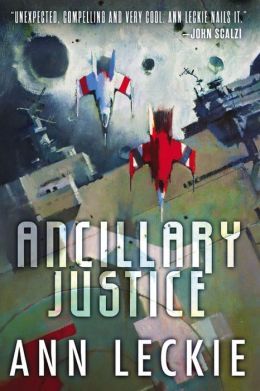
Another winning recommendation from Annie. Anne Leckie’s Ancillary Justice deserves all the awards and commendations it has received and then some. It won’t be up everyone’s alley, but for me, I can easily put it in my top dozen favorite reads.
Briefly, Leckie’s website summarizes the book as follows:
On a remote, icy planet, the soldier known as Breq is drawing closer to completing her quest.
Breq is both more than she seems and less than she was. Years ago, she was Justice of Toren–a colossal starship with an artificial intelligence linking thousands of corpse soldiers in the service of the Radch, the empire that conquered the galaxy.
An act of treachery has ripped it all away, leaving her with only one fragile human body. And only one purpose–to revenge herself on Anaander Mianaai, many-bodied, near-immortal Lord of the Radch.
Basically we have an epic, lovely space opera with a militaristic society, complex AI, and an absence of gender (as we see it). Breq and the entire Radch society only use feminine pronouns (she, her, sister, daughter, etc.). Now, there are indeed different sexes, but it simply does not matter to the main civilization. It is only through interactions of other races that gender becomes an issue (really more of an issue of propriety but little else).

Special Edition Artwork by Lauren Saint-Onge
Now, you may think this means the entire novel is about gender, but really it is more powerful that gender isn’t an issue at all. Leckie’s real power is her storytelling, her ability to create a complex society within a detailed universe seemingly thousands of years old filled with developed characters who struggle with their own sense of identity and purpose and the morality of their choices. She tackles really deep existential concepts, that moment of self-awareness and “becoming,” and she does so artfully for both the more advanced as well as the common reader of sci-fi. In the end, gender doesn’t matter to what is an overall incredible and meaningful story.
These themes of identity, meaning, and morality are what stand out to me the most. Of course, the single gender pronoun grabbed me and the concept presents great ideas for discussion, but Breq (or Justice of Toren) is more importantly an example of self-reflection and growth, of facing down destiny, and of learning how we can operate as individuals as well as part of a community (and how important both things are).
I’m not sure any of this makes sense unless you delve into Ancillary Justice. For me, it took me back to some of my favorite philosophical discussions, and I hope my saying so doesn’t deter potential readers. Leckie’s work just hit me that hard. I will be reeling from it for months and years. If you like well written sci-fi, you’ll enjoy this book. After all, there is a reason Ancillary Justice is the first book to receive all three major awards-The Hugo, Nebula, and Arthur C. Clarke awards-for Best Novel.
 Merely Creative
I’ve seen this book in orbit on my radar but now I definitely need to move it up my TBR list!
LikeLike
It’s definitely worth the read! I hope you enjoy it!
LikeLike
I saw ‘worldbuilding’ and I was scared. For many people, worldbuilding is just throwing in every small detail as if it means anything. I’m glad to hear what you loved in it was the depth and What It Means. I’ve been waiting for someone to mix the fun Space Opera with literary fiction.
LikeLike
I guess world building can be a bit vague of an explanation. What I actually mean is that Leckie makes her world real. In fact she doesn’t just sit there and tell you the details of this new universe, she spreads it out for you to discover through out the book which makes it all the more believable.
LikeLike