Playing Catch Up on my Spring Reading – Books #18-22

After last month’s lengthy and much needed blog post, I realized I needed to play catch up in other regards as well.  I would like to spend more time on the creative, personal, as well as fun, but I cannot do that if I let these older reviews I put off clog my blog space.  Not to short change any of them, mind you, but after so much time, I cannot do them much justice in their own lengthy posts anyway.  So, here are some short rundown’s on 5 of the books from my Spring Reading.

Really, all I need to say here is that I have yet another example of a book that just really isn’t quite up my alley.  Tananarive Due’s The Good House is not a bad book, but it isn’t really my style. In short: Angela Toussaint hopes that returning to her Grandma Marie’s house, the house of her youth, will bring her some peace, but tragedy follows. Five years later, she returns, hoping to face the demons of her son’s death and let them go.  But ghosts and real demons follow, and Angela is left to puzzle out the pieces and solve the mystery her son’s death.

A haunting tale, with horror and mystery, you would think I’d embrace it.  But truthfully, I didn’t connect to the characters or story as much as I thought I would.  I know this is more me than the quality of the writing or the story itself. It is an interesting tale, but it is a little predictable with too nice of a bow on top.  It reads more as ghost-story written for the NON-ghost crowd rather than them being the primary audience.
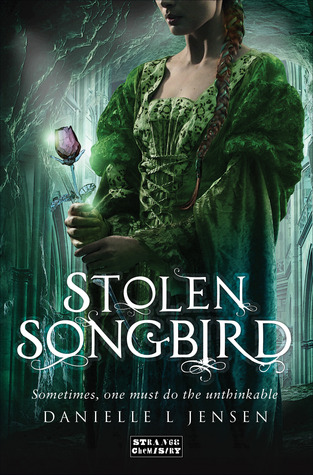
Next up we switch to a very different genre, young adult fantasy.  Stolen Songbird, by Danielle L. Jensen is a bit of a misleading title. On the eve of leaving her home town to study music with her mother, Cecile is kidnapped and forced to marry the Prince of the Trolls.  Trapped under the mountain, where a powerful witch has cursed them, the trolls hope the marriage between human and troll will lift their 500 year old curse.  When it doesn’t, Cecile is thrust into a confusing world of politics, betrayal, and unexpected love.

With such a summary, it is no wonder I picked it up: fantasy, music, politics…wooo! However, it is also still a young adult novel…I should have kept that in mind.  Music, or singing, has VERY little to do with the novel, and the annoying romance tropes of “pretending to hate each other” play out here.  But, the politics and intrigue are interesting. The world is interesting, if a little flat, and while I want to see where she takes her version of “trolls,” I’m not necessarily sure I like it.  I might read the rest of the series eventually, but I’m not in a rush.
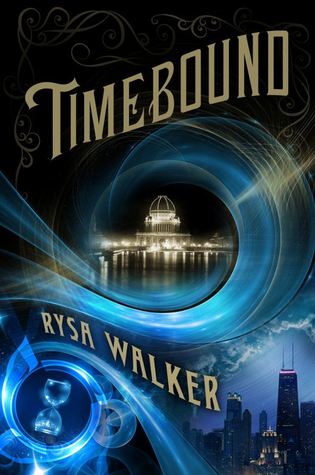
The next book, #20, was a bit of a surprise for me.  Rysa Walker’s Timebound was one of those free E-books I picked up on a whim. It took me about a year to actually decide to read it, and I didn’t expect much.  However, I was incredibly impressed.  Is it great literature? Definitely not. But, it does embrace originality.  Kate is given a strange glowing medallion and told that she has inherited the ability to travel through time. She doesn’t believe it for a second until her world is turned upside down with time shift.  Kate must then travel to 1893 to prevent a murder that threatens her entire future without altering it further.

Overall, it’s a quick, fun read that doesn’t over complicate (or over simplify) time travel and it’s theoretical problems.  Plus, through in a little YA romance, historical fiction, and good old adventure/mystery, and you can’t go wrong.
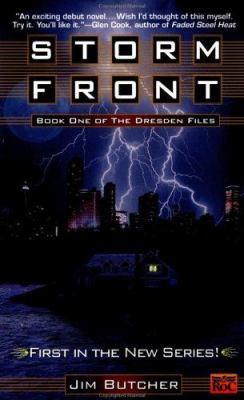
I know I said I’d NEVER read Jim Butcher, but I gave in since one of my very best friends kept recommending it. So for #21, I gave in and tried Storm Front, book #1 of the Dresden Files.  Harry Dresden is a Wizard for hire, a Paranormal Investigator. The Chicago PD comes to him for help with a dark double murder where black magic is involved, and it’s up to Harry to stop him

Honestly, with my preconceived notions of this series, it wasn’t quite as bad as I thought it would.  However, I’m still not a huge fan. I’ve been told it gets better, but Dresden is a bit misogynistic, having a thing for the damsel in distress.  I’ll give Butcher some credit though, his women aren’t necessarily weak and the world is intriguing.  I’d like to understand more of his method of urban fantasy.  Still, the story is fairly flat and not really my thing. Eventually, I’ll probably try some more (see Cort…I keep my promises eventually)!
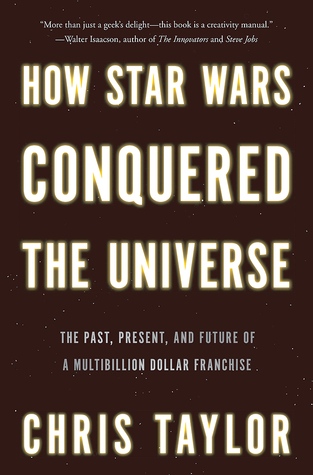
I picked up this book basically because it was an Audible Daily Deal, but I am SOOOOOO happy I did.  Chris Taylor’s How Star Wars Conquered the Universe: The Past, Present, and Future of a Multibillion Dollar Franchise, is not only incredibly informative, it’s a well written analysis of our popular culture.  Essentially, it’s a biography of the Star Wars franchise, not just one person but the entire dream, development, cultural obsessions, fandoms, etc.  It embraces all aspects and doesn’t shy from questioning the creative vision when needed. Really, it’s a lovely balance of fact, fun, and analysis.  If you like Star Wars at all, I HIGHLY recommend it.

More coming soon….I promise!
Book #24 – The Slow Regard of Silent Things, by Patrick Rothfuss

Alright folks, batten down the hatches, I’m going rogue!

Okay, not really, but I AM jumping ahead. I can’t wait…seriously…it’s not happening on this one folks. I know my last review was book #17, but I seriously just finished book #24 in my year of reading, and I can’t put off talking about it…especially since there is a Worldbuilder’s Indiegogo campaign going on for JUST THIS WEEK! Geeks Doing Good FTW!

Patrick Rothfuss has been warming my heart all over this year.  His short little novella, The Slow Regard of Silent Things certainly is no different. I know, I know. The diehard fans all cried a little when it came out..”What?! It’s NOT Kvothe?! It’s not BOOK THREE?!!! GAH!”  Still, most fans are also excited just to have more of Rothfuss’ work, and personally, this novella is just a treasure trove of joy. Plus, the artwork by Nate Taylor is not to be missed.

First of all, you need to know, obviously this book has almost nothing to do with the main storyline of The Kingkiller Chronicles.  It’s a short character development piece on Auri, one of the more mysterious, odd characters of the series and also one of Rothfuss’ favorites (and mine). He doesn’t hide the fact that this is very different. He’s not shy about the fact that he knows his fans are impatient for book three.  In fact, in his introduction he seems to almost warn people away in a, “be ready, you may not like it, but I like it…and these other people like it…so here it is…maybe you’ll like it” kind of way.  I’ve seen the reviews, I’ve heard the mixed reception.  In fact, two of my friends who read Rothfuss way before me each had what were probably common reactions. One basically said “It’s okay, but come on, just write the next damn book!”  The other, “It’s not what I expected, it’s alright, but you…you’ll love it.”

He. Was. Correct.

I’ve loved Auri from her first introduction. A story entirely her’s is long overdue, at least for my wandering, word heavy, poetry hungry mind.  Rothfuss weaves his magic in a strange yet simple third person narrative of Auri’s life in The Underthing.  Auri is preparing for a visit with Kvothe (rather, for a visit with him).  She has seven days until his arrival, and the Rothfuss invites the reader to follow along, to discover how Auri fills her days, the challenges she faces, how she survives, and simply, to experience a taste of how she sees things and really lives them.

Is she a bit off-kilter? Yes. Is the Underthing a beautiful dream-home. No. Does this story have a typical plot structure (beginning, middle, end…etc.). Also, NO.  Does it work. YES.  Auri seems to dance through life, not let it drag her down. And yet, this dancing is not always lighthearted or safe or even a dance of joy. It is something like dancing on the edge of the darkness, living in that space between dream and awake…where you don’t know which way you would rather turn.  Auri lives constantly in that space, and Rothfuss creates that space here. From what I’ve seen,Taylor’s artwork also helps to flesh out this almost-shadow reality where Auri seems to gleam and glint in her own light. Yes, like many of my books, I listened to the audio (I’ll get there in a moment).  But, I’ve already broken down and ordered my own (autographed) edition…yes, I really do love it that much.

However, getting to the audiobook, it honestly probably couldn’t be better! Of course, it helps that it is read by none other than Rothfuss himself (though Nick Podehl reads both The Name of the Wind & Wise Man’s Fear and I am kind of in love with him as a reader… seriously…I just purchased my fourth book with him as the narrator).  Usually, I am hesitant of author readings. Sometimes they are amazing (this is a case in point), but let’s be honest, to make an audio book come alive, sometimes there also needs to be a level of distance from the creator.  In this case, Rothfuss’ love of Auri shines through, and he makes the 3.5 hour audiobook an incredible experience where the poetry simple slips in and out even more clearly! It might also be that he just has a great reading voice (despite the second thoughts he expresses on his blog).  I actually wonder if some people who couldn’t handle reading this book would do better listening to it. The words and phrasing are so fluid that the book almost begs to be heard.
If you haven’t gotten it by now, I have a love for beautiful words and phrases and poetic sensibilities…and strangeness.

I can’t recommend this book enough (though, yes, you might not like it). Even if you haven’t read the other books, you may find yourself gloriously surprised here.  The Slow Regard of Silent Things stands alone as its own little work of art.  Jason Heller over at NPR sums it up nicely:

“Slow Regard is its own defense, a charming, lyrical meditation on the meaning of home: how we define it, how we carry it with us, and how we deal with the lure and fear of what lies beyond.”

Whether you are a fan or not, I urge you to go look at the Geeks Doing Good 2015 Campaign on Indiegogo. Three days in, and they’ve already raised over $100,000 for Heifer International. Rothfuss has declared it “The Year of the Gear in honor of Auri and The Slow Regard of Silent Things (it makes sense if you read the book).  There are all sorts of lovely wonderful things, and it’s all for a good cause.  I’m trying not to dump my entire wallet over there actually…because yes…I am having an obsessive moment.

“When all the world was a palimpsest, it was a perfect palindrome.” ~The Slow Regard of Silent Things, by Patrick Rothfuss.

Book #17 – Saga: Volume 4, by Brian K. Vaughan and Fiona Staples

Wow, I’m managing to do more than one review in a week! Woo! Who knows, I might be able to catch up sometime soon…maybe…possibly…

okay, probably not…

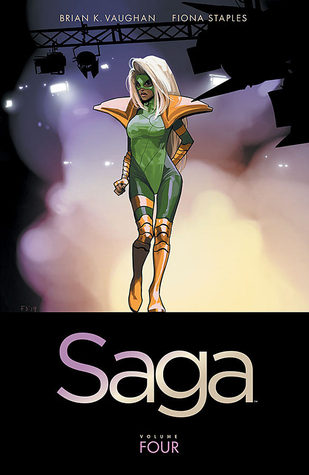
On to another graphic novel:  Saga: Volume Four by Brian K. Vaughan & Fiona Staples.  If there is any new graphic novel or comic series you start reading this year, SAGA should be it.  Image Comics is producing some stellar work lately (This is Robert Kirkman’s label, of Walking Dead fame) and Vaughan’s work is among the best.  Beautiful art, classic story (lovers from opposite sides of a galactic war), intertwined with some twisted characters, difficult decisions, and a strange, ever growing intergalactic system.

The comic is ongoing, and each volume collects 6 issues into one collection.  The world keeps growing, and sometimes the characters can be difficult to keep track of.  However, if you were to read them more regularly, as each serial came out, it might be simpler to track.  Likewise, you could just wait until more of the series is developed. I’m sure we’ll see these volumes turned into larger compendiums.

Volume 4 lost my interest a bit in part because it introduced addiction and infidelity into the main characters’ relationship.  I understand the desire to add a personal struggle into the already existing universal issues, but it felt almost forced.  However, Vaughan and Staples have a strong track record, and I think they’ll use it to build the adventure part of the tale (which seems to always seems to be expanding).

If anything loses your interest in the series, it might be the constant action and jumping between our characters.  While there is depth and beauty and violence, and LOTS of action, the story could do with a big more grounding.  However, we’re still early on in the series. There is so much potential and so much to enjoy in Saga that I’m not ready to give up on it yet. Instead, I’ll impatiently wait for the next one, just like everyone else.

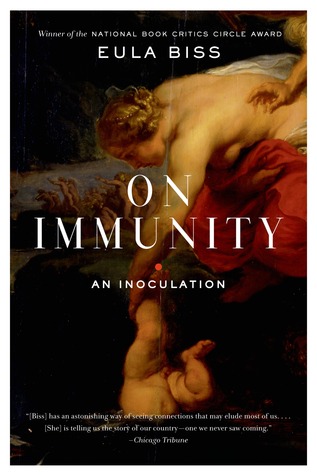
Book #16 – On Immunity: An Innoculation, by Eula Biss

A little outside my norm, but Eula Biss’ book, On Immunity: An Inoculation, is well worth the deviation.  Biss takes on the highly publicized Anti-Vaccination movement that has been sweeping the US, and yet she does so in a non-agressive, completely approachable way.  I cannot recommend this book enough! Whether you simply want to know more about vaccines and their history, or you’re really debating to vaccinate your children, Biss provides answers.

As a mother herself, Biss talks directly to the audience most directly affected by and directly causing the current vaccine/no-vaccine issues: The Parents.  She points out the fears of parenting: the worrying over what is right and wrong, what will cause your children harm, what will save them…where do you draw the line?!  These are natural, normal, and completely understandable. Just because you want the best and safest route for your children does not make you crazy for worrying over things you’ve been told may harm them!  However, Biss does not shirk her responsibilities: sometimes, the reward FAR outweighs the risk, as in the case of vaccinations.

Biss’ main thesis is that vaccinating is far safer and effective than not vaccinating, but it is alright to have questions and be cautious.  She sprinkles in history, science, ethics, and the moral issues surrounding vaccinations.  All of these serve to not only inform but to hopefully show the doubting reader an answer: choose vaccines, because even with the worries, they’re worth it.

My review may be short and glowing, but I can’t talk too much without telling you her entire book. In short, I recommend it for those interested in understanding how vaccines developed and why people fear them. More importantly, I definitely recommend it for those afraid of vaccinating their children. Biss really does a stellar job of targeting her audience without alienating them.  Give this book to anyone you know who doesn’t understand why vaccinations matter!

Book #15 Circle of Reign – by Jacob Cooper

I’ve been putting off doing this review on purpose.  This is one of those books I kind of hated at first, but by the end, I had to admit it had some good moments. Still, this might be the first review here where I’m not 90%+ positive in my reaction (maybe not even 50%).
That being said, let’s get down to it…

Circle of Reign, is Jacob Cooper’s first novel.  If you want the summary follow the link. It’s a bit too much for me to really explain concisely.  When I picked it up on Audible (it was a Daily Deal), I was intrigued by the concept of a new epic fantasy utilizing Light & Dark in a new way, and I had no idea it was a self published work.  I hold nothing against self published works, they simply aren’t my first choice when looking for books.  The reviews are generally glowing, and the first hour or so of listening was really exciting!  And then…it went downhill.

Don’t get me wrong, Cooper does create a complex new world.  He introduces a magic system and land that I do want to learn more about, but I’m just not sold on it.

First, as another reviewer put it, he’s just begging for an editor.  I just listened to the audio, so I didn’t see grammatical errors, but he occasionally uses words that just sound fancy and don’t fit.  Now, I have a decent vocabulary and I like a solid, complex vocabulary in books.  What Cooper does here makes it sound like he is honestly just trying too hard.  He also falls into the trap of creating a language…without creating a language. He includes complicated made up words and immediately explains them with the English. Yes this can be done effectively, but here it feels clunky and forced. Again, I attribute this to just trying too hard.

Second, character development is almost non-existent.  There is a brief effort with the two main characters, but I don’t feel like Cooper thinks of them as breathing creations, which characters should be to any author.

Third, the book tries to be as political as other major epic fantasy series, without actually bothering to delve into the politics much.  Everything feels skimmed, brushed, but never explored.  I saw a positive review that compares this book to Brandon Sanderson “except less nerdy and more gritty.”  Well, it’s grittier because it is rougher in both language and especially political plot…and can’t pull off the finesse of Sanderson or George R.R. Martin. Cooper definitely is influenced by the two of these authors.  However, Sanderson and Martin are all about complex plots, twists, political intrigue, and world disaster.  Cooper attempts to pull on these elements, but doesn’t quite succeed.

Still, I can’t be all negative. Though it took me a long time to force myself to read, by the last third of the novel, I didn’t want to put it down. Yes, part of that was because I knew I was nearing the end, but I also got wrapped up in the action.  Here Cooper starts to hint at a larger mythology, and he starts to build a battle scene that could rival other epic fantasy battles.  In the end, I felt like it was a let down and a bit predictable. I am curious to see what happens next, but if he doesn’t get an editor or a mentor on his writing style, I don’t know if I can put myself through another book.  It’s actually sad because Cooper really has the basic blocks to what promises to be a great concept/world/story.  The execution is just lacking.  However, I’m glad other people have latched onto it. His creativity certainly needs to be lauded even if he isn’t very polished.  I hope he improves and succeeds eventually, but I do suggest you go into the book only if you can look past the rougher edges.

And that’s all I’ve got!

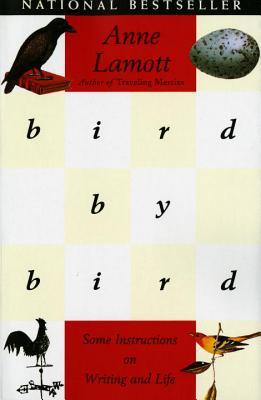
Book #14 – Bird by Bird: Some Instructions on Writing and Life, by Anne Lamott

So I finished this book about a month ago at this point…I really need to start writing these reviews quicker so I can be more thorough! As it is, it isn’t difficult to appreciate the beauty and guidance of Anne Lamott’s Bird by Bird: Some Instructions on Writing and Life.  I was introduced to Lamott’s work, specifically this one, back in my Master’s Degree program, by the wonderful Dr. Barbara Price.  Though we read pieces, we never read the entire book, and when focusing on how to teach writing to others, it isn’t necessary to read the entire memoir.  However, I do recommend it.

Bird by Bird is exactly what it states: part instructional guide for the would be writer, and part memoir.  Several parts are easily quotable: snippets to pull out and put on an embroidered pillow, or an internet meme.  But there is really marrow beneath this fragile bones.  Lamott is a gloriously funny writer, willing to bare her pains and mistakes and successes so that her readers may learn from them.  Through her experiences, the reader discovers insight to the self as well as the page.

I wish I hadn’t waited so long to write this review. I also wish I had a physical copy of the book (something I”ll remedy) since I read this through an audiobook.  This is the type of book I would scribble endlessly in the margins, dogearing the most important pages, and sending poignant sections to those around me.  It made me want to write more and provided the tools to start (which I promptly ignored if you can tell from my semi-absence on this blog).  Still, I’m glad I listened to it.  I’m going to use it as my occasional “self-help” book..something for a bit of motivation and inspiration.

Thanks Anne Lamott. I promise to do better by you, even if it isn’t by much. Thank you for your words.

Book #13 – Beautiful Creatures, by Kami Garcia & Margaret Stohl

I’ve been keeping up with all my reading, honest…just not the blogging portion.  I finished Beautiful Creatures (Caster Chronicles #1), by Kami Garcia & Margaret Stohl, about a month ago, so really this review will be short because I should’ve probably written it right away…woe is me.

If you like supernatural, southern, high school romance, young adult, paranormal fiction (yes, really ALL those descriptors are needed) than this one is for you. Ethan Wate is a high school basketball player in a small southern town where he feels his life wasting away, even more so after the death of his mother and with his father eternally locked in his study. All of that changes when Lena Duchannes moves into town. The niece of the town recluse, she is odd, in all the wrong ways for small town life but all the right ways for Ethan. The pair quickly bonds despite the entire town fighting to keep them apart. Of course it helps that they pair have been dreaming of each other since before they ever met, and they can has each other’s thoughts.

However, Lena is not mortal. She is a Caster (basically magical/witch/spellcaster/powerful/generic supernatural being), and on her 16th birthday, she will be turned either good or evil…. Light or Dark.

From there, you can guess where the story goes: young love, lots of obstacles, a mystery, a family curse, attempting to control one’s own destiny, etc. Basically, Beautiful Creatures is your typical YA supernatural romance including some of my least favorite YA stereotypes such as the girl in need of rescuing, the mean girl, and the secretly smart jock. However, it does have a few things that make it stand apart. For instance, Ethan is the narrator. Having the male lead narrate is rare in the female driven supernatural YA world. Garcia and Stohl make him a credible voice in their universe. In fact, most of their characters, the main ones at least, are well written and believable. The story, while not entirely unique, is still interesting with a few fun twists.

Overall, I enjoyed the story, but I wasn’t overwhelmed with excitement. I also don’t have an urgent desire to read the rest of the series. I might pick them up one day….

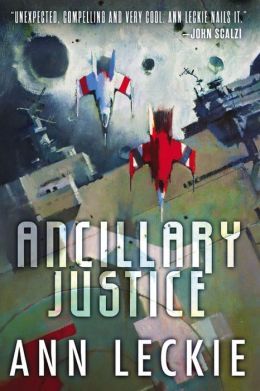
Book #12 – Ancillary Justice, by Anne Leckie (or Guess Who Found a New Favorite Book)

Another winning recommendation from Annie.  Anne Leckie’s Ancillary Justice deserves all the awards and commendations it has received and then some. It won’t be up everyone’s alley, but for me, I can easily put it in my top dozen favorite reads.

Briefly, Leckie’s website summarizes the book as follows:

On a remote, icy planet, the soldier known as Breq is drawing closer to completing her quest.

Breq is both more than she seems and less than she was. Years ago, she was Justice of Toren–a colossal starship with an artificial intelligence linking thousands of corpse soldiers in the service of the Radch, the empire that conquered the galaxy.

An act of treachery has ripped it all away, leaving her with only one fragile human body. And only one purpose–to revenge herself on Anaander Mianaai, many-bodied, near-immortal Lord of the Radch.

Basically we have an epic, lovely space opera with a militaristic society, complex AI, and an absence of gender (as we see it).  Breq and the entire Radch society only use feminine pronouns (she, her, sister, daughter, etc.).  Now, there are indeed different sexes, but it simply does not matter to the main civilization. It is only through interactions of other races that gender becomes an issue (really more of an issue of propriety but little else).

Special Edition Artwork by Lauren Saint-Onge

Now, you may think this means the entire novel is about gender, but really it is more powerful that gender isn’t an issue at all.  Leckie’s real power is her storytelling, her ability to create a complex society within a detailed universe seemingly thousands of years old filled with developed characters who struggle with their own sense of identity and purpose and the morality of their choices.  She tackles really deep existential concepts, that moment of self-awareness and “becoming,” and she does so artfully for both the more advanced as well as the common reader of sci-fi.  In the end, gender doesn’t matter to what is an overall incredible and meaningful story.

These themes of identity, meaning, and morality are what stand out to me the most.  Of course, the single gender pronoun grabbed me and the concept presents great ideas for discussion, but Breq (or Justice of Toren) is more importantly an example of self-reflection and growth, of facing down destiny, and of learning how we can operate as individuals as well as part of a community (and how important both things are).

I’m not sure any of this makes sense unless you delve into Ancillary Justice.  For me, it took me back to some of my favorite philosophical discussions, and I hope my saying so doesn’t deter potential readers. Leckie’s work just hit me that hard.  I will be reeling from it for months and years.  If you like well written sci-fi, you’ll enjoy this book.  After all, there is a reason Ancillary Justice is the first book to receive all three major awards-The Hugo, Nebula, and Arthur C. Clarke awards-for Best Novel.

Book #10 – The Handmaid’s Tale, by Margaret Atwood

It should be no surprise to anyone that I’m writing about this book.  It should surprise you that it has taken me this long into my life to actually read Atwood. What have I been doing with the last 30 years of my life?!

The Handmaid’s Tale is one of those landmark texts, the kind that generations upon generations of inspired readers share, handing you their well loved, worn copy. Looking at you with gleaming, affected eyes, they eagerly push the book into your hand with a smile that reads of change and opened minds.

Maybe I’m being too sentimental and overselling Atwood.  Still, my point is that The Handmaid’s Tale was written with an important purpose, and 30 years later it still excels at that purpose. (Well I’ll be damned…I just realized that this year is the 30th anniversary of the book…huh…perfect!).

The premise is as follows:

In the not so distant future, the United States has erupted into a completely different world known as Gilead.  In response to increasing liberalism, feminist movements, changing views on religion, etc., Gilead has restructured the entire nation, issued total control over the remaining society, and outlawed anything and everything from women in the workplace to wearing makeup to printing books,  Only one state religion is allowed and women possess only 3 jobs: Wife, Martha, or Handmaid (though you could count the Aunts as a fourth, but they’re an extension of the Handmaid).  Women exist to serve their roles as related to their house and man. This is how they contribute to the greater good of society.

Atwood focuses on the Handmaid, Offred (Literally Of Fred). Most of her days are spent alone, in silence. She is not allowed to read. She leaves the house once a day to purchase food at the market.  Monthly she goes through the Ceremony where she has sex with the Commander (aka Fred), hoping to conceive by him. Offred is one of the valuable women who still have viable ovaries in this transitional society. If she cannot conceive, she will be deemed worthless.

First Edition Cover (source Wikipedia)

Atwood fills Offred’s days with monotony, reflections on her life as it as, and dreams of her life before. We are given glimpses of her lost hopes, her missing family, the horrors of the transition into the Handmaid’s role, and her struggles in her current household where she just wants to survive a little longer. She can barely even hope to find a way out. The story is structured to make us feel the sluggish, oppressive, passing of time, the tense fear of committing the slightest sin. The whole society, not just women, are controlled and stifled to an extreme.

In the extremeness of her story, Atwood creates a lens through which we can critique our current culture.  The world of Gilead is just a funhouse mirror version of our own, twisted, curved and quite cracked.  Still, its basic structure comes from our world’s very real issues with gender roles (male as well as female), religious influence, political power, and the domestic space of the home.  The norm of the world is a blanket we wrap around ourselves.  Atwood’s ability to tear it away through her close scrutiny is why The Handmaid’s Tale remains a phenomenal unconquerable text.

Obviously, I’ve touched on perhaps my favorite discussion point, so I’ll share a few texts below if you’re interested in further reading. Many more exist, but these are ones I’ve found particularly enlightening.

Of Woman Born: Motherhood by Experience, by Adrienne Rich.*                  *This one above all closely relates to Atwood’s work.

The Feminine Mystique, by Betty Friedan.

The Second Sex, by Simone de Beauvior.

Sexual Politics, by Kate Millett.

I’d love to hear your thoughts or any books, articles, (non-fiction or fiction), you would like to share!

Book #9 – Rebel Angels, by Libba Bray

Since I took so long to complete the 4 reviews for the rest of my February books, I ended up filling some of my reading with somewhat lighthearted fair. After Wool, I couldn’t delve quickly into something very complex (just too many thoughts). So, I read Libba Bray’s second book in the Gemma Doyle series, Rebel Angels.  That statement may, in fact, be a bit misleading since the world of Gemma Doyle is actually a bit complex, if not the deepest.  What I really love is that Bray has some of the loveliest blending of history and fantasy I have ever come across.

The basic premise for the series is as follows:  Gemma Doyle is a 16 year old girl living in India with her family in 1895.  After her mother’s mysterious death, the family returns to England and Gemma is shipped off to Spence, a girl’s boarding school.  Once there, she must deal with strange visions, a mysterious boy following her, and of course the social society of teenage girls.  Magic and tense friendships send her on a strange journey to understand who she is and the legacy her mother left her.

I cannot praise Bray enough as an author, and I’ve really just dipped my toes into her works.  However, since the Gemma Doyle series is her first full series, some of it is a bit rough around the edges. I loved book #1, A Great and Terrible Beauty, with it’s very well researched Victorian setting, ties to India, and mythical, mysterious, magical Realms.  Plus, I LOVE it when I can’t quite see all the twists coming (keep me guessing guys, it’s way more entertaining that way).

Rebel Angels, book #2, picks up where book #1 ends with only a short gap of time, and unfortunately it seemed stretched a bit thin at parts (specifically where the magic is involved).  Regretfully, I also saw the twist coming from approximately page 10.  I was actually angry when my suppositions ended up being the supposed “twist.” Sometimes, it’s okay, because the author has kept me guessing even if I see the twist, or “think” I see it.  That didn’t happen here.

Despite that, I still recommend Rebel Angels.  I’ll be starting Book #3 sometime in the near future, so I can see if she strengthens anything there. I know part of the problem with the series is because it is her first.  Diviners is just plain amazing, so it’s nice to see her depth and style develop.

On a side note, if you’re bored, go read Libba Bray’s bio on her website. It just makes me happy…