

Alright folks, batten down the hatches, I’m going rogue!
Okay, not really, but I AM jumping ahead. I can’t wait…seriously…it’s not happening on this one folks. I know my last review was book #17, but I seriously just finished book #24 in my year of reading, and I can’t put off talking about it…especially since there is a Worldbuilder’s Indiegogo campaign going on for JUST THIS WEEK! Geeks Doing Good FTW!
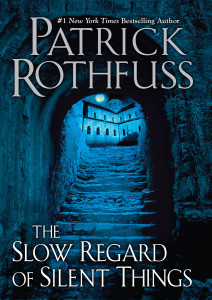
Patrick Rothfuss has been warming my heart all over this year. His short little novella, The Slow Regard of Silent Things certainly is no different. I know, I know. The diehard fans all cried a little when it came out..”What?! It’s NOT Kvothe?! It’s not BOOK THREE?!!! GAH!” Still, most fans are also excited just to have more of Rothfuss’ work, and personally, this novella is just a treasure trove of joy. Plus, the artwork by Nate Taylor is not to be missed.
First of all, you need to know, obviously this book has almost nothing to do with the main storyline of The Kingkiller Chronicles. It’s a short character development piece on Auri, one of the more mysterious, odd characters of the series and also one of Rothfuss’ favorites (and mine). He doesn’t hide the fact that this is very different. He’s not shy about the fact that he knows his fans are impatient for book three. In fact, in his introduction he seems to almost warn people away in a, “be ready, you may not like it, but I like it…and these other people like it…so here it is…maybe you’ll like it” kind of way. I’ve seen the reviews, I’ve heard the mixed reception. In fact, two of my friends who read Rothfuss way before me each had what were probably common reactions. One basically said “It’s okay, but come on, just write the next damn book!” The other, “It’s not what I expected, it’s alright, but you…you’ll love it.”
He. Was. Correct.
I’ve loved Auri from her first  introduction. A story entirely her’s is long overdue, at least for my wandering, word heavy, poetry hungry mind. Rothfuss weaves his magic in a strange yet simple third person narrative of Auri’s life in The Underthing. Auri is preparing for a visit with Kvothe (rather, for a visit with him). She has seven days until his arrival, and the Rothfuss invites the reader to follow along, to discover how Auri fills her days, the challenges she faces, how she survives, and simply, to experience a taste of how she sees things and really lives them.
Is she a bit off-kilter? Yes. Is the Underthing a beautiful dream-home. No. Does this story have a typical plot structure (beginning, middle, end…etc.). Also, NO. Does it work. YES. Auri seems to dance through life, not let it drag her down. And yet, this dancing is not always lighthearted or safe or even a dance of joy. It is something like dancing on the edge of the darkness, living in that space between dream and awake…where you don’t know which way you would rather turn. Auri lives constantly in that space, and Rothfuss creates that space here. From what I’ve seen,Taylor’s artwork also helps to flesh out this almost-shadow reality where Auri seems to gleam and glint in her own light. Yes, like many of my books, I listened to the audio (I’ll get there in a moment). But, I’ve already broken down and ordered my own (autographed) edition…yes, I really do love it that much.
 However, getting to the audiobook, it honestly probably couldn’t be better! Of course, it helps that it is read by none other than Rothfuss himself (though Nick Podehl reads both The Name of the Wind & Wise Man’s Fear and I am kind of in love with him as a reader… seriously…I just purchased my fourth book with him as the narrator). Usually, I am hesitant of author readings. Sometimes they are amazing (this is a case in point), but let’s be honest, to make an audio book come alive, sometimes there also needs to be a level of distance from the creator. In this case, Rothfuss’ love of Auri shines through, and he makes the 3.5 hour audiobook an incredible experience where the poetry simple slips in and out even more clearly! It might also be that he just has a great reading voice (despite the second thoughts he expresses on his blog). I actually wonder if some people who couldn’t handle reading this book would do better listening to it. The words and phrasing are so fluid that the book almost begs to be heard.
If you haven’t gotten it by now, I have a love for beautiful words and phrases and poetic sensibilities…and strangeness.
I can’t recommend this book enough (though, yes, you might not like it). Even if you haven’t read the other books, you may find yourself gloriously surprised here. The Slow Regard of Silent Things stands alone as its own little work of art. Jason Heller over at NPR sums it up nicely:
Whether you are a fan or not, I urge you to go look at the Geeks Doing Good 2015 Campaign on Indiegogo. Three days in, and they’ve already raised over $100,000 for Heifer International. Rothfuss has declared it “The Year of the Gear“ in honor of Auri and The Slow Regard of Silent Things (it makes sense if you read the book). There are all sorts of lovely wonderful things, and it’s all for a good cause. I’m trying not to dump my entire wallet over there actually…because yes…I am having an obsessive moment.
“When all the world was a palimpsest, it was a perfect palindrome.” ~The Slow Regard of Silent Things, by Patrick Rothfuss.


 Merely Creative